 Cart is empty
ITALIANO
A cosa serve il soffietto grandangolare?
A prima vista sembra un accessorio un po’ strano: al posto delle pieghe regolari del soffietto tradizionale, una sacca morbida collega le due standarte. Ma il soffietto grandangolare, chiamato anche soffietto a sacco o floscio, risponde a un problema molto concreto.
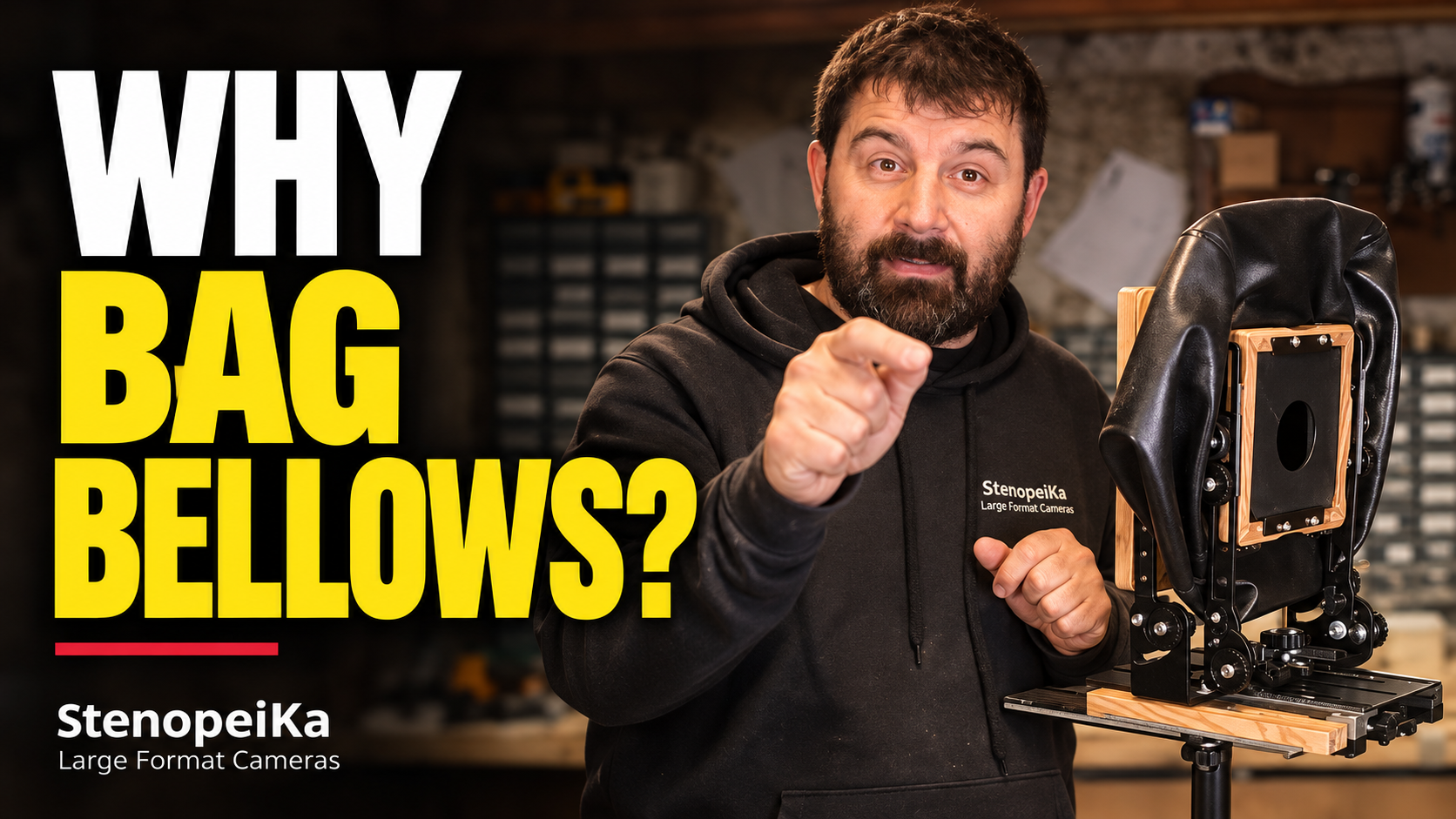
Nel nuovo video dalla bottega lo mostro su una Michelangelo 4×5 in ulivo con soffietto blu, confrontando la libertà di movimento dei due tipi di soffietto.
Guarda il video completo
Parlato in italiano, con sottotitoli inglesi.
Corte focali, standarte vicine
Quando si usano obiettivi grandangolari sul grande formato, l’obiettivo deve trovarsi vicino al piano pellicola. Questo porta le due standarte ad avvicinarsi e il soffietto tradizionale a comprimersi.
Le pieghe, così raccolte, possono diventare rigide e opporsi ai movimenti della fotocamera. Nel video mostro come la situazione cambi quando le standarte sono più distanti e come la libertà si riduca avvicinandole.
Perché usare un soffietto a sacco
Il soffietto grandangolare è morbido e privo di pieghe fisse. Permette quindi di avvicinare molto le standarte lasciando maggiore libertà alla standarta anteriore.
Nella dimostrazione provo il decentramento e il basculaggio anteriore, sia dalla lensboard sia dalla base. È questa la sua utilità: conservare la possibilità di comporre e lavorare con i movimenti anche alle corte estensioni richieste dai grandangolari.
Per approfondire
Nel video segnalo l’articolo di Alberto Lagomaggiore dedicato agli obiettivi grandangolari su Large Format Diary #05, settembre 2026. Un approfondimento per continuare a esplorare il tema oltre alla dimostrazione pratica.
- Scopri il soffietto grandangolare StenopeiKa
- Michelangelo 4×5: la versione attuale mk2
- Leggi di più su Large Format Diary #05
Tu quali grandangolari usi? Ti è mai capitato di trovare il soffietto troppo rigido per il movimento che volevi fare?
📬 Per ricevere novità dal laboratorio, nuovi prodotti e i prossimi “Cosa bolle in pentola?”, iscriviti alla newsletter.
Un saluto dalla bottega,
Samuele
StenopeiKa — Large Format Cameras
ENGLISH
What are wide-angle bellows for?
At first glance, they look a little unusual: instead of the regular folds of ordinary bellows, a soft bag connects the two standards. But wide-angle bellows, also known as bag bellows, solve a very practical problem.
In the new workshop video, I demonstrate them on a Michelangelo 4×5 in olive wood with blue bellows, comparing the freedom of movement offered by the two types.
Watch the full video
Spoken in Italian, with English subtitles.
Short focal lengths, close standards
When you use a wide-angle lens on a large format camera, the lens needs to sit close to the film plane. This brings the two standards closer together and compresses ordinary pleated bellows.
With the folds packed together, the bellows can become stiff and resist camera movements. In the video, I show how things change when the standards are farther apart and how that freedom decreases as they come closer together.
Why use bag bellows?
Wide-angle bellows are soft and have no fixed pleats. They allow the standards to come very close together while leaving more freedom at the front standard.
In the demonstration, I try front shift and front tilt, using both the lensboard pivot and the base pivot. That is the practical benefit: retaining the movements you need to compose and work at the short extensions required by wide-angle lenses.
Further reading
In the video, I recommend Alberto Lagomaggiore’s article on wide-angle lenses in Large Format Diary #05, September 2026. It is a useful way to explore the subject further after the practical demonstration.
- Explore StenopeiKa wide-angle bellows
- Michelangelo 4×5: the current mk2 model
- Find out more about Large Format Diary #05
Which wide-angle lenses do you use? Have your bellows ever been too stiff for the movement you wanted to make?
📬 For workshop news, new products and upcoming “Cosa bolle in pentola?” newsletters, subscribe here.
Best wishes from the workshop,
Samuele
StenopeiKa — Large Format Cameras
